
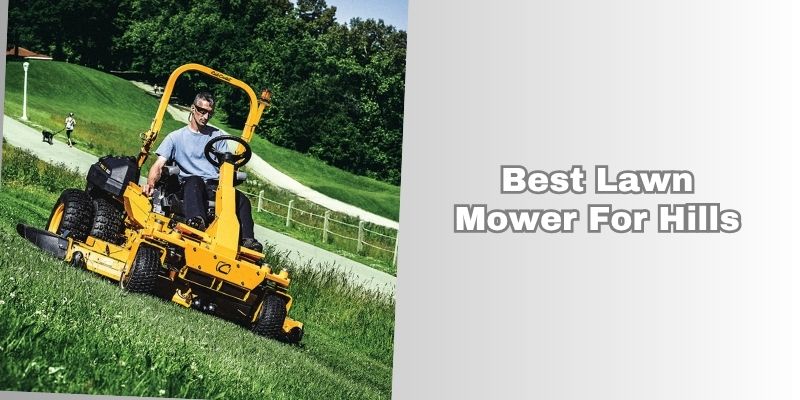
Mowing steep ground isn’t just tiring; it can quickly become dangerous if your machine lacks grip or feels too heavy to balance. Finding the Best Lawn Mower For Hills comes down to matching your yard’s specific angle with the right drive setup, whether that means hands-off robotic power, a remote crawler, or a lightweight manual tool. You don’t have to guess which model will keep its footing without tearing up your turf. This guide compares real listed capabilities to help you decide which machine fits your slope best.
Our Picks
| # | Product | ||
|---|---|---|---|
| 1 |  | DREAME A3 AWD Best Overall | Check Price |
| 2 |  | INFRONT Remote Control Best for Extreme Slopes | Check Price |
| 3 |  | WORX Robot 4WD Best Robotic Traction | Check Price |
| 4 |  | Greenworks 40V Push Best Lightweight Push | Check Price |
| 5 |  | LawnMaster Push Reel Best Manual Reel | Check Price |
| 6 |  | BLACK+DECKER 3-in-1 Best Compact Electric | Check Price |
1. (Upgraded) DREAME A3 AWD 1000 LiDAR Robot Lawn Mower
Best for: Steep yards needing fully hands-off robotic upkeep
The DREAME A3 AWD relies on all-wheel drive hub motors designed to master 80% (38.7°) inclines and roll over 2.17-inch obstacles. Its 360° LiDAR and Binocular AI vision map lawns without boundary wires or an RTK station, avoiding more than 300 common objects under tree cover or near walls. It recharges in 45 minutes using an included 5A adapter to maintain areas spanning 0.25 to 0.50 acre.
Operating this unit saves physical labor on slopes, but its coverage ceiling means it isn’t meant for sprawling estates larger than a half-acre. You can schedule runs day or night through the Dreamehome App with its built-in 4G module, while edges trim within 1.97 inches on its own.
Pros
- Climbs steep inclines up to 80%
- Fast forty-five minute recharge time
- No boundary wire installation required
Cons
- Limited to half-acre yard sizes
- Trimmer module sold separately
2. Infront Remote Control Lawn Mower
Best for: Harsh, overgrown banks demanding distant operator control
The INFRONT Remote Control mower handles severe terrain using a crawler track design coupled with a 225CC gas engine and gas-electric hybrid power system. It navigates 45° steep slopes while keeping the operator safe thanks to a remote control distance reaching 700 meters. Its zero-turn capability allows smooth pivots around thick brush or sudden drop-offs.
This machine delivers a wide 19.68-inch cutting width and remotely adjusts its deck from 0.79 to 5.9 inches, but managing fuel and batteries across two systems requires regular mechanical upkeep. It’s not a fit for suburban buyers who want silent, autonomous clipping without manual remote steering. Dual alloy blades also feature rebound protection when striking hidden objects.
Pros
- Operates remotely up to 700 meters
- Tackles extreme 45 degree slopes
- Remotely adjustable five-inch height range
Cons
- Requires active manual remote guidance
- Gas hybrid demands regular maintenance
3. WORX Robot Lawn Mower 4WD
Best for: Complex half-acre hills needing precise edge trimming
The WORX Robot 4WD utilizes a terrain-adaptive chassis and true front-wheel steering to climb steep grades up to 84% (~40°) without tearing delicate turf. Its Centimeter-level RTK Cloud Accuracy requires no physical antenna setup or extra subscription fees, falling back on V-SLAM sensor fusion when working under dense shade trees.
Its Cut-to-Zero offset blade cuts exceptionally close to fixed borders, which cuts down on post-mow weed whacking. However, with capacity capped at 1/2 acre, this robot isn’t built for massive acreage. Owners can manage unlimited mowing zones through mobile controls while Find My Landroid GPS tracking guards against theft.
Pros
- Claws up 84% slope inclines
- No local antenna or cloud fees
- Offset blade trims close borders
Cons
- Maximum yard size is half-acre
- App requires active cellular connection
4. Greenworks 40V 16in Push Lawn Mower
Best for: Moderate inclines where a lighter push deck helps
The Greenworks 40V Push features a plastic construction that sits 35% lighter than steel deck mowers, making it far easier to push uphill. Its single 4.0Ah battery cuts yards up to 1/3 acre on one charge, supported by a single lever 5-position height adjustment mechanism. The mower offers 2-in-1 mulch and rear bagging to manage clippings easily.
Because it lacks driven wheels, pushing this mower up steep inclines still relies entirely on human muscle, meaning it isn’t suited for very steep embankments or large properties. However, its tool body shares battery compatibility with over 75 Greenworks 40V tools, backed by a 3-year limited warranty.
Pros
- Lightweight deck maneuvers easily uphill
- Backed by three-year limited warranty
- Compatible across 40V tool platform
Cons
- Requires manual pushing on grades
- Limited to one-third acre lawns
5. LawnMaster LMRM1801 Push Reel Lawn Mower 18-Inch 5-Blade
Best for: Small, gentle slopes needing quiet manual clipping
The LawnMaster Push Reel runs on pure human power, using an 18-inch 5-blade cutting reel that slices grass cleanly like scissors instead of tearing it. The deck rides on 10-inch front wheels to ease forward movement, offering 9 cutting positions spanning from 1.1 inches to 2.5 inches.
Because it’s a completely motorless design with no engine assist, cutting tall, thick grass on steep inclines requires heavy physical effort, making it a poor choice for uneven or heavily pitched ground. It includes a collection bag and durable steel blades, ensuring simple mechanical reliability without gas, oil, or battery charging.
Pros
- No gas or battery required
- Nine quick-change height positions
- Includes grass clipping collection bag
Cons
- Heavy physical effort on inclines
- Cutting height tops at 2.5-inches
6. BLACK+DECKER Electric Lawn Mower
Best for: Small sloped patches needing mixed trimming and edging
The BLACK+DECKER 3-in-1 merges a 6.5 amp motor and POWERDRIVE Transmission with a detachable MTD100 mower deck for triple-duty chores. Running at 8000 RPM, its 12-inch cutting width handles tight nooks, small hills, and steep ditch banks where wide decks can’t balance. An Automatic Feed Spool (AFS) continuously supplies line without manual tapping.
Its compact footprint lets you trim awkward angles without losing footing, but the physical extension cord limits your operating radius and creates a tripping hazard on steep grades. It’s clearly not designed for medium or large lawns, featuring a single fixed 1.6-inch cutting height in mower mode.
Pros
- Converts between mower, trimmer, edger
- Compact size fits tight banks
- Reliable continuous line autofeed system
Cons
- Power cord limits travel distance
- Single fixed mowing height setting
Where These Overlap
Several of these machines target similar slope problems with different mechanical methods. The DREAME A3 AWD and WORX Robot 4WD share nearly identical roles; both navigate up to half-acre properties, tackle massive slopes around 80% to 84%, and eliminate boundary wires completely. Choosing between them rests on whether you prefer the rapid 45-minute charge of the DREAME model or the Cut-to-Zero offset blade of the WORX. Meanwhile, the manual push options from Greenworks 40V Push and LawnMaster Push Reel overlap in property size, yet the battery motor on the Greenworks spares your legs far more effort on inclines.
How We Picked
To find the top choices, we compared 30 Amazon listings for slope-capable equipment, screening published traction capabilities, drive mechanics, cutting widths, and stated slope limits. We focused purely on listing figures, included hardware, and manufacturer warranties rather than lab testing or field trials. Every slope rating and feature comes directly from the brands’ product sheets without any outside score adjustments.
Still Not Sure?
How steep is your yard’s incline?
If you’re facing extreme hillside drops or rough ditch terrain over 40 degrees, standard rolling push mowers risk dangerous slips. Choosing an aggressive crawler track setup like the INFRONT Remote Control protects you by moving the operator up to 700 meters away from the incline.
How much physical pushing do you want to avoid?
Mowing a hilly yard by hand quickly strains your back and calves, especially during hot summer months. If you prefer to skip the physical pushing entirely, an autonomous unit with all-wheel drive hub motors like the DREAME A3 AWD climbs steep turf automatically while you rest.
What works best for small patches?
Small yards with sharp terraces don’t always justify the space or setup of large robotic mowers or heavy tracks. For compact properties with gentle slopes and nearby exterior power outlets, the multi-use BLACK+DECKER 3-in-1 lets you mow, trim, and edge steep banks with total control.
The DREAME A3 AWD stands out as the best overall pick for hands-off slope maintenance, while the INFRONT Remote Control provides the heavy-duty muscle needed for extreme, overgrown inclines. Check your yard’s steepest grade with a simple slope angle app before ordering to secure the right machine.
FAQ
Can robotic mowers really climb steep hills without slipping?
Yes, models engineered with dedicated all-wheel drive hub motors or terrain-adaptive four-wheel drive can climb steep turf up to 80% or 84% grades. Their low center of gravity and specialized tread patterns maintain ground traction where heavy push mowers might slide.
Why choose a remote control mower over a robotic one?
A remote-controlled tracked mower gives the operator manual command over tall weeds, brush, and harsh steep banks from a safe distance for nearly an hour of continuous operation. Robotic mowers focus on routine turf maintenance rather than clearing thick brush or uneven wilderness.
Is a lighter push mower safer on hills?
A lighter mower, such as a battery push model with a lightweight deck, requires significantly less upper-body strength to push uphill and won’t roll down as aggressively if you pause. However, it still requires proper foot traction to prevent user slips.
Do wire-free robotic mowers lose navigation signal on shaded hills?
Modern wire-free units combine visual sensor cameras, V-SLAM technology, and cloud-assisted RTK or LiDAR to navigate smoothly beneath dense tree cover, preventing dropouts along shaded hillsides.
Conclusion
Tackling sloped turf successfully requires prioritizing traction systems, machine weight, and hill incline limits over simple cutting power. Matching your yard’s grade to the right machine ensures clean grass without risking personal injury. Choose the model that fits your hillside terrain best and take back your weekends.